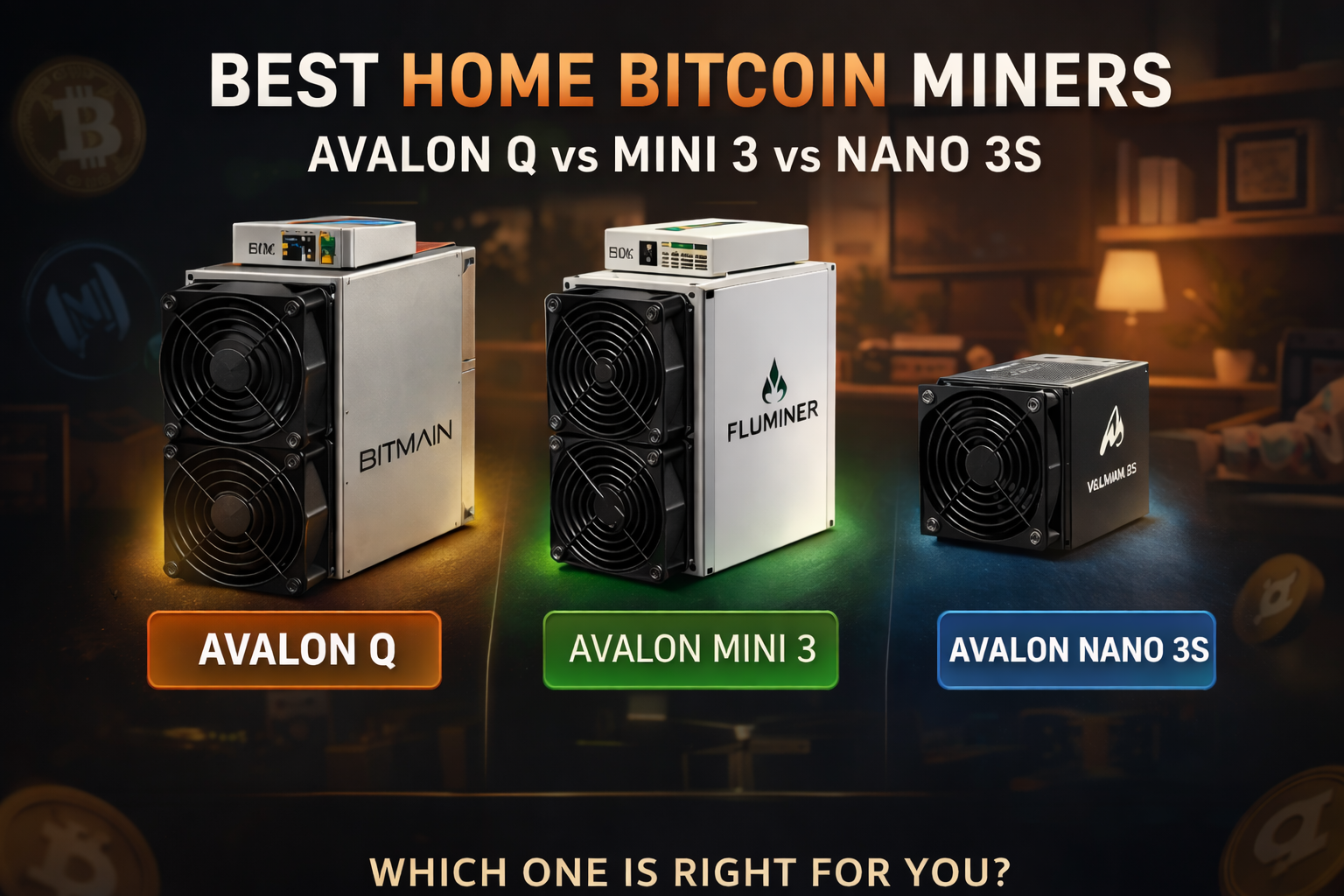

Choosing the right Avalon home miners for home Bitcoin mining can honestly make or break your experience. Some people jump in expecting easy profits, only to get frustrated by noise, heat, or electricity bills. That’s why Avalon’s latest home miners, the Nano 3S, Mini 3, and Avalon Q—are getting so much attention right now.
Each of these machines is built for a different type of users. The Avalon Q is clearly the powerhouse, pushing up to 90 TH/s, while the Nano 3S keeps things simple and beginner-friendly at just 6 TH/s. Then you have the Mini 3 sitting right in the middle, offering a mix of performance and practicality.
What makes these miners interesting is that they’re designed for real homes, not just warehouses or industrial farms. That alone changes how you should think about mining in 2026.
A Quick Look at Avalon Q, Mini 3, and Nano 3S
If you’re trying to decide between these three avalon home miners, it really comes down to how involved you want to be and what your setup looks like.
The Avalon Q feels like bringing industrial mining into your house, just without the extreme noise and complexity. It’s powerful, flexible, and surprisingly manageable for something pushing 90 TH/s.
The Mini 3 is more creative. It doesn’t just mine Bitcoin, it also works as a heater. That might sound like a gimmick at first, but when you actually think about it, turning mining heat into something useful is pretty smart, especially in colder seasons.
Then there’s the Nano 3S, which is easily the most approachable of the three. It’s small, quiet, and doesn’t demand much power. If you’re new to mining, this is the one that lets you learn without feeling overwhelmed.

Performance and Power: What You’re Really Getting
Hashrate is usually the first thing people look at when purchasing avalon home miners, and for good reason, it determines how much work your miner can do.
The Avalon Q dominates here with up to 90 TH/s. That’s serious performance, and it’s adjustable too, meaning you can scale power usage depending on your electricity cost.
The Mini 3 delivers a steady 37.5 TH/s, which is more than enough for most home miners who want solid output without going all-in.
The Nano 3S, at 6 TH/s, obviously isn’t competing with the other two in raw power. But that’s not really the point. It’s designed to be efficient, simple, and accessible.
What’s interesting is that all three allow some level of power tuning. You’re not locked into one mode—you can adjust based on your situation, which is something a lot of beginners overlook.
Efficiency Matters More Than You Think
A lot of people focus only on hashrate, but efficiency is what actually affects your profit long term.
The Avalon Q leads again with 18.6 J/TH, making it the most efficient of the three. That’s a big deal if you’re running it daily.
The Mini 3 follows at 21.3 J/TH, which is still solid and competitive.
The Nano 3S comes in at 23.3 J/TH. It’s not the most efficient, but considering how little power it uses overall, it still makes sense for smaller setups.
In simple terms, the more efficient your miner is, the less you spend on electricity to get the same results.
Setup, Control, and Everyday Use
One thing Avalon did right with these miners is keeping them user-friendly.
You don’t need to be a tech expert to get started. All three models support simple setup through a browser or app, and you can monitor everything in real time—hashrate, temperature, performance, all of it.
The Avalon Q gives you more connectivity options, including WiFi and Ethernet. The Mini 3 is flexible too, while the Nano 3S keeps things simple with app-based control.
For most people, especially beginners, this makes a huge difference. Nobody wants to spend hours just trying to get a miner running.
Size, Noise, and Living With It
This is where avalon home miners really becomes different from industrial mining.
The Nano 3S is tiny, almost like a book—and super quiet. You could literally keep it on your desk without it bothering you.
The Mini 3 is bigger and produces more heat, but that’s kind of the point. It’s designed to warm your space while mining.
The Avalon Q is the largest and most powerful, so naturally, it produces more noise and heat. But compared to traditional industrial miners, it’s still manageable.
If you’re planning to mine at home, this part matters more than people think. A loud machine running 24/7 can quickly become a problem.
Real-World Performance (Not Just Specs)
On paper, specs look great—but real performance tells the real story.
The Nano 3S actually performs slightly better than advertised, hitting around 6.3 TH/s in testing. That’s a nice bonus for something in its category.
The Mini 3 stays consistent, even when running in different modes, which is important if you’re relying on it long term.
The Avalon Q delivers exactly what you’d expect—strong, stable performance in the 85–95 TH/s range depending on how you configure it.
Pricing: Avalon Home Miners
What is the price of these avalon home miners?
Right now, you’re looking at roughly:
The Nano 3S sits around $210 to $300, making it the cheapest entry point.
The Mini 3 is in the $800 to $900 range, which feels fair considering what it offers.
The Avalon Q comes in higher, between $1,350 and $2,000, depending on availability and demand.
At first glance, the Nano 3S looks like the best deal—but when you look at performance per dollar, the Avalon Q actually gives you more value long term.
Avalon Home Miners (Profitability and ROI)
The Nano 3S earns very little daily, and depending on your electricity cost, it might not break even anytime soon.
The Mini 3 does better, and when you factor in its heating ability, it becomes more practical than it looks on paper.
The Avalon Q is where things start to make more financial sense. With good electricity rates, it can pay itself off in about a year to a year and a half.
But here’s the truth most people don’t say, profitability depends heavily on your electricity cost. That’s the biggest factor.
So, Which One Should You Go For?
It really depends on what you want out of mining.
If you’re just starting and want to learn without spending too much, the Nano 3S is the safest choice.
Choose Mini 3 if you like the idea of combining mining with something useful like heating, the Mini 3 is surprisingly practical.
If your goal is performance and actual returns, then the Avalon Q is the clear winner.
Final Thoughts
Home mining in 2026 isn’t about competing with big farms. It’s about finding something that works for your situation.
The Avalon Q, Mini 3, and Nano 3S each offer a different path into Bitcoin mining. None of them are “perfect,” but each one fits a specific type of user.
If you approach it with the right expectations—especially around electricity and ROI—you can still make it work.
FAQs
Is the Avalon Nano 3S worth it?
It’s worth it if you want to learn mining without spending much. Just don’t expect big profits.
How much can the Avalon Q make daily?
Around $3 to $4 before electricity, depending on conditions.
Which one is best for home use?
The Nano 3S is the easiest to live with, while the Mini 3 adds heating benefits.
Is mining still worth it in 2026?
Yes, but only if your setup makes sense—especially your electricity cost.