
Avalon Nano 3 vs 3S — what’s the real difference, and which one should you buy? At first glance, they look almost identical. Same compact design, same home-friendly concept, same low power usage.
If you’ve been digging into home Bitcoin mining lately, you’ve probably noticed something interesting—more people are moving away from loud, industrial machines and looking for something smaller, quieter, and easier to run at home
That’s where devices like the Avalon Mini 3 and Avalon Nano 3S comes in.
But before you jump in, there are a few questions that keep popping up:
- What actually makes the Avalon Mini 3 special?
- Is the Avalon Nano 3S even profitable?
- How much power do these machines use?
- And how do they compare to high-end miners?
Let’s break everything down in a simple, real-world way so you can understand exactly what you’re getting into.
Why the Avalon Mini 3 Is Getting So Much Attention
The Avalon Mini 3 sits in a very interesting position in the mining world.
It’s not a tiny experimental device like some USB miners, and it’s not a massive industrial machine either. Instead, it’s built for people who want real mining performance without turning their home into a noisy server room.
What makes it stand out is its balance.
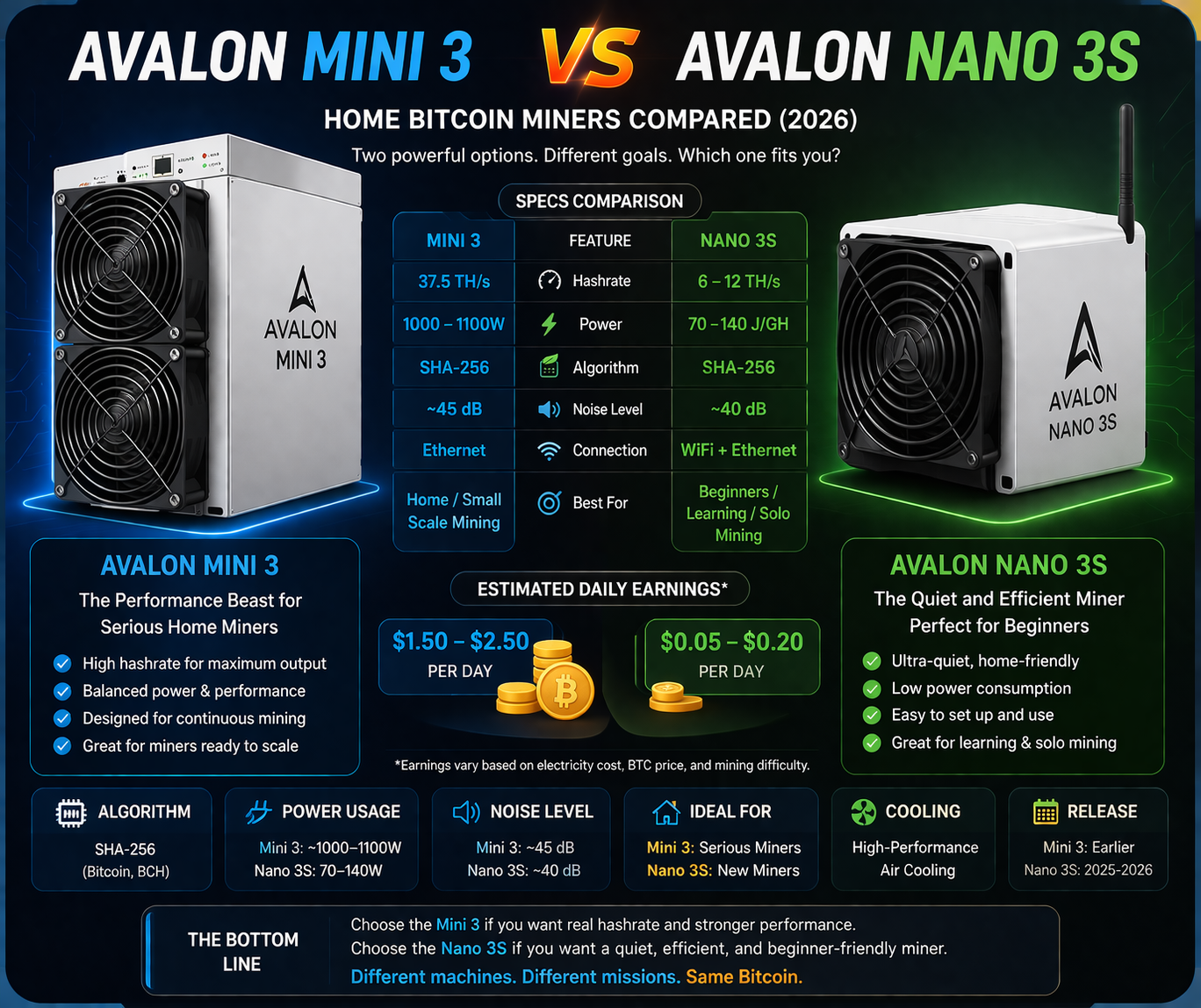
You’re getting a hashrate of around 37.5 TH/s, which is actually quite powerful for a home-friendly setup. That’s already a huge jump compared to smaller desktop miners…
At the same time, it doesn’t go overboard with power usage or noise like large-scale ASIC rigs. It’s designed to be something you can realistically run in a controlled home environment.
That’s why a lot of people see it as a bridge between beginner mining and serious mining.
Power Consumption: What You Need to Know
One thing many beginners underestimate is electricity.
The Avalon Mini 3 typically uses around 1000W to 1100W, which puts it somewhere in the middle:
- Higher than small hobby miners
- Lower than industrial machines that go above 3000W
In real life, that means:
- You can run it at home
- But you still need to think about electricity costs
If your power is expensive, it can eat into your profits quickly. But if you have stable and affordable electricity, this is where the Mini 3 starts to make more sense.
What Coins Can Avalon Mini 3 Mine?
The Avalon Mini 3 is designed for one main purpose:
Mining Bitcoin using the SHA-256 algorithm
This also includes:
- Bitcoin (BTC)
- Bitcoin Cash (BCH)
- Other SHA-256-based coins
Unlike GPUs that can switch between different coins, this is a dedicated Bitcoin miner. It’s built for efficiency, not flexibility.
Is Avalon Nano 3S Profitable?
Now let’s talk about the Avalon Nano 3S, because this is where expectations need to be realistic.
At first glance, it’s an attractive option:
- Compact size
- Very quiet
- Low power usage
But here’s the honest truth:
This is not a profit-first miner.
What You Actually Earn
On average, the Nano 3S might generate:
- Around $0.05 to $0.20 per day
Yes, that’s small.
But that doesn’t mean it’s useless, it just means you need to understand its purpose.
The Real Value of the Nano 3S
People don’t buy the Nano 3S to get rich.
They buy it because it offers something different:
- A way to learn Bitcoin mining hands-on
- A quiet device you can run anywhere
- A chance to participate in solo mining (like a lottery)
- A fun way to stay connected to the Bitcoin network
Some users even treat it like a dual-purpose device—a small heater that also mines Bitcoin in the background.
Hashrate: How Powerful Is the Avalon Nano 3?
The Avalon Nano 3 series, including the 3S, typically runs between:
6 TH/s to 12 TH/s depending on settings
To put that into perspective:
- It’s much stronger than USB miners
- But far below industrial ASIC machines
This places it firmly in the entry-level home mining category.
What About the Highest Hashrate Miners?
If your goal is maximum performance, you’ll quickly notice that machines like the Nano 3S or Mini 3 are not at the top.
The highest hashrate miners in 2026 include:
- Antminer S21 series
- Advanced hydro-cooled systems
- Large scale ASIC setups
These can reach 200 TH/s and beyond, with some pushing even higher.
But Here’s the Trade-Off
High-performance miners come with:
- Much higher power consumption
- Extreme noise levels
- Significant heat output
That’s why most people don’t run them at home.
Avalon Mini 3 vs Nano 3S: What’s the Real Difference?
This is where things become clearer,
The Nano 3S is built for simplicity:
- Small
- Quiet
- Beginner-friendly
The Mini 3 is built for performance:
- Much higher hashrate
- More serious mining potential
- Higher energy usage
Simple Way to Think About It
- Nano 3S is like “I want to try mining at home”
- Mini 3 is “I want to actually mine with meaningful output”
Which One Should You Choose?
It all comes down to your goal.
Go for Avalon Nano 3S if:
- You want something quiet and simple
- You’re just starting out
- You’re curious about Bitcoin mining
- You don’t mind low earnings
Go for Avalon Mini 3 if:
- You want real mining performance
- You’re ready to handle higher power usage
- You’re thinking long-term
- You want better output
Is It Worth It in 2026?
Let’s be honest.
YES — if you understand what you’re buying
These miners are worth it if you:
Want to learn mining
Enjoy the process
Have a long-term mindset
Understand electricity costs
NO — if you expect quick profits
Avoid them if you are
Expecting fast ROI
Want daily income
Don’t factor in power costs
Final Thoughts
When you look at all the questions people ask about these miners, one thing becomes clear:
There’s no “one size fits all” answer.
The Avalon Nano 3S is perfect for beginners who want a quiet and simple entry into mining.
The Avalon Mini 3 is better for those who want to take things a step further and actually generate meaningful hashrate.
Conclusion
- Avalon Nano 3S is Simple, quiet, beginner-friendly
- Avalon Mini 3 is More powerful, more serious mining
In the end, it’s not about which miner is better, It’s about which one fits your goals.