
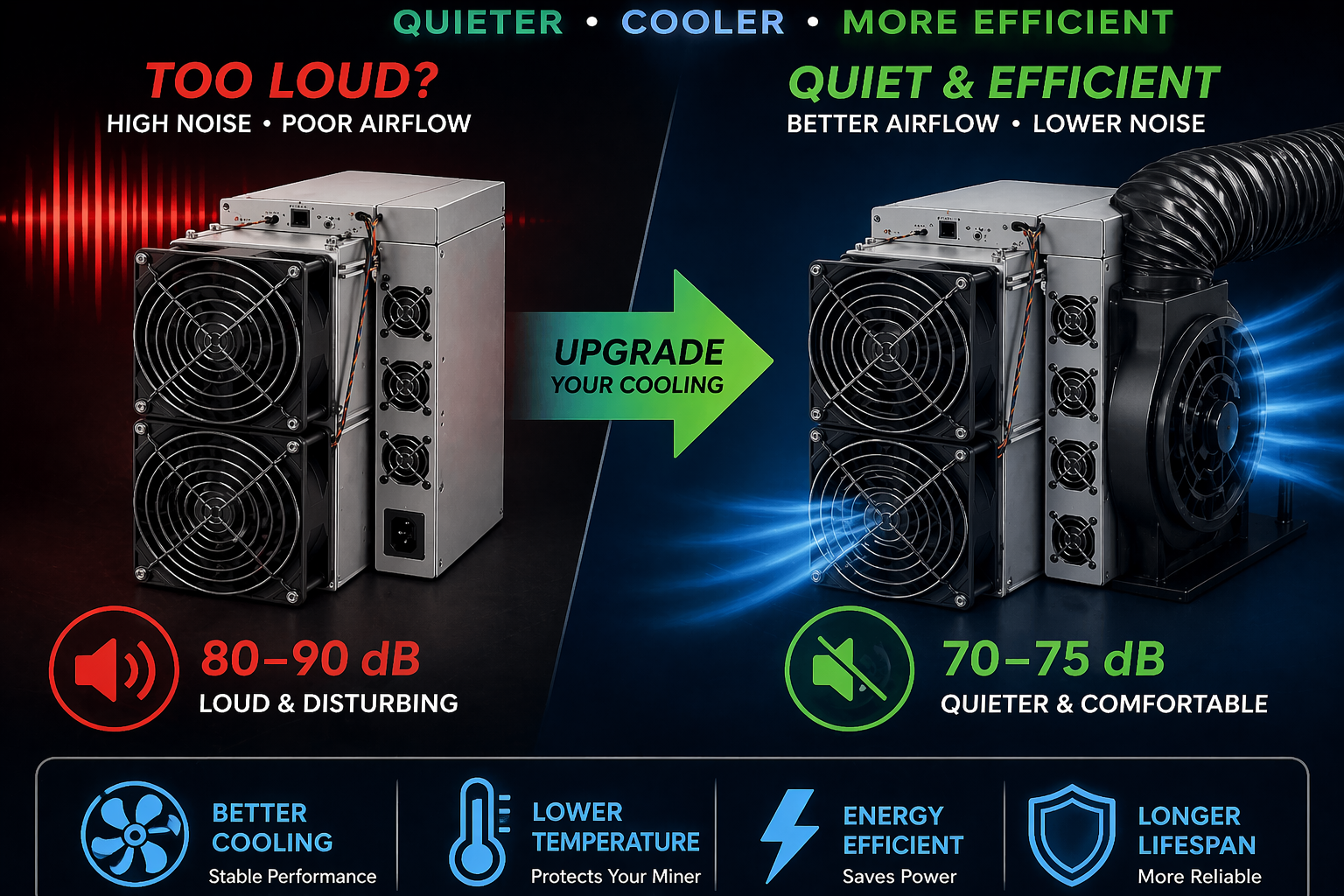

If you’ve ever powered on your mining rig and immediately thought, “Why is my ASIC miner so loud?” — you’re definitely not alone. I’ve been there too. From my own mining setup, one thing became clear very quickly: a loud ASIC miner isn’t usually a fault — it’s the result of how these machines are designed to survive extreme heat.
In fact, most Bitcoin miner noise comes down to two things: aggressive cooling systems and inefficient airflow design. The stock fans inside most ASIC miners are built for industrial environments, not homes or small setups. They spin at very high speeds to keep temperatures under control, and that’s where the noise problem begins.
Over time, after testing different configurations, airflow tweaks, and cooling upgrades, I realized something important — you don’t have to live with the noise. With the right adjustments, you can significantly reduce it and even build a relatively quiet bitcoin miner setup without sacrificing performance.
Let’s break it all down.
How Loud Is an ASIC Miner, Really?
Most people underestimate just how loud these machines are until they hear one in person.
A typical ASIC miner sound level ranges between 75 dB and 90 dB. To put that into perspective:
- Around 70 dB = vacuum cleaner
- 80–85 dB = busy street traffic
- 90 dB = motorcycle engine
Now imagine that running 24/7 in your room or workspace.
From experience, running a noisy crypto miner indoors without modifications is not sustainable. It becomes distracting, stressful, and in some cases, unbearable.
What Actually Causes ASIC Miner Noise?
When you strip everything down, ASIC miner noise isn’t random — it’s predictable. It usually comes from a combination of these factors:
1. High Fan Speed (RPM)
Stock cooling fans are designed to run at extremely high speeds. The hotter the miner gets, the faster the fans spin — and the louder they become.
2. Poor Airflow Design
If airflow inside or around your miner is restricted, heat builds up quickly. The system reacts by increasing fan speed, which increases noise.
3. Heat Accumulation
ASIC chips generate a lot of heat. Without efficient heat dissipation, the cooling system has to work harder, creating more noise.
4. Stock Cooling Limitations
Most factory-installed fans prioritize cooling performance, not noise reduction. They’re powerful, but not optimized for quiet operation.
So in reality, a loud ASIC miner is not a defect — it’s a trade-off between cooling efficiency and acoustic comfort.
Why Stock Cooling Systems Are So Noisy
Here’s something many beginners don’t realize: ASIC miners were never designed for home use.
Stock cooling systems are built for:
- Mining farms
- Warehouses
- Industrial environments
That’s why they:
- Run at maximum RPM
- Push aggressive airflow
- Ignore noise levels completely
This is why Antminer noise (and similar models) is notoriously high. The goal is simple: keep the machine cool at all costs.
But that doesn’t mean you can’t improve it.
The Hidden Factor: Airflow and Noise
One of the biggest lessons I learned from my own setup is this:
Airflow is just as important as the fan itself.
Bad airflow leads to:
- Hot air getting trapped
- Uneven cooling across components
- Increased fan speed
- More turbulence (which = more noise)
Good airflow, on the other hand:
- Keeps temperatures stable
- Reduces fan workload
- Minimizes noise output
If you fix airflow, you often reduce noise without even changing the fan.
How to Measure ASIC Miner Sound Level
Before making changes, you need a baseline.
Here’s a simple way to measure your ASIC miner sound level:
- Use a decibel meter app on your phone
- Stand about 1 meter away from the miner
- Record the noise level
- Repeat after making changes
This helps you clearly see whether your upgrades are actually working.
How to Reduce ASIC Miner Noise (What Actually Works)
After testing multiple setups, these are the strategies that consistently make the biggest difference:
1. Upgrade to an ASIC Blower Fan
Switching from stock fans to a blower-style fan can:
- Improve airflow direction
- Reduce turbulence
- Lower overall noise
Unlike traditional fans, blower fans push air more efficiently through a controlled path.
2. Improve Airflow Design
This is often overlooked but extremely powerful.
Simple improvements include:
- Creating a clear air intake and exhaust path
- Avoiding airflow blockage
- Positioning the miner properly
Better airflow = less heat = lower fan speed = less noise.
3. Use Ducting Systems
Ducting is one of the most underrated noise reduction methods.
It works by:
- Channeling hot air away
- Reducing sound spread in your room
- Improving cooling efficiency
In my setup, adding ducting made a noticeable difference almost immediately.
4. Perform an Antminer Fan Upgrade
A proper Antminer fan upgrade is one of the fastest ways to reduce noise.
Instead of:
- Loud, high-RPM stock fans
You use:
- Optimized, quieter alternatives
This upgrade alone can significantly improve your experience.
Best Cooling Upgrades for a Quiet Bitcoin Miner
If you want to go beyond basic tweaks, dedicated cooling kits are where things really improve.
To build a quiet bitcoin miner, you need a combination of:
- Efficient airflow
- Controlled fan speed
- Noise-optimized components
This is where professional cooling systems outperform DIY fixes.
CM Series Cooling Kits (Practical Solutions)
From hands-on experience, these types of cooling kits make a real difference:
CM01 – Silent ASIC Cooling Kit
- Power: 180W
- Noise Level: ~70 dB
- Airflow: 1200 m³/h
- Speed: Variable control
Best for: Maximum noise reduction with strong airflow.
CM02 – Energy Efficient Cooling Kit
- Power: 135W
- Noise Level: ~74 dB
- Airflow: 800 m³/h
Best for: Lower power consumption setups.
CM03 – Duct Cooling Fan System
- Power: 180W
- Noise Level: ~72 dB
- Airflow: 1000 m³/h
Best for: Controlled airflow with ducting integration.
CM04 – Smart Temperature-Controlled Fan
- Power: 180W
- Noise Level: ~72 dB
- Auto speed adjustment
Best for: Hands-off temperature management.
BUY CM03 COOLING KIT
In my own setup, switching to similar solutions didn’t just reduce noise — it actually improved cooling efficiency and system stability.
Real Talk: Can You Make an ASIC Miner Truly Silent?
Short answer: No.
Long answer: You can make it much quieter and manageable.
Even with upgrades:
- You won’t get silence
- But you can reduce noise to tolerable levels
The goal isn’t silence — it’s control.
Final Thoughts: Building a Quiet Mining Setup
If you’re dealing with a noisy crypto miner, here’s what you should remember:
- Noise is mainly caused by cooling, not the miner itself
- Airflow design is just as important as fan quality
- Stock systems are built for performance, not comfort
- Upgrading your cooling setup is the most effective solution
With the right approach, you can transform a loud, aggressive mining rig into something far more manageable — even in a small-scale or semi-indoor setup.
And once you experience that difference, you’ll never go back to stock cooling again.
If you’re serious about improving your setup, start with airflow, then upgrade your fans, and finally consider a full cooling kit. That’s the exact path that worked for me.
